Search

Random Recipe

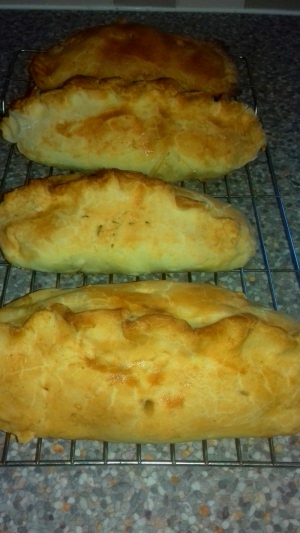
Proper Pasty Recipe

Proper Pasty RecipeOK it's not really a Cornish Pasty as Sue cooked it in York. But it's well worth the effort. Even if you're going to call it a Goole or Wetwang Pasty!
 
Ingredients for the filling:-
 
500g Beef, diced
Swede, Carrots and Parsnips, diced
2 Onions, diced
1 Baking Potato, diced 
1 tbls of fresh Thyme
Salt and ground Black Pepper
Paprika
 
Egg Wash:-
 
1 large beaten egg with 1 tbls of water
 
For the pastry:-
 
500g of bread Flour (Gluten free if required)
120g of Lard
1 tsp od Salt
25g of Margarine
175ml water
1 large Egg
 
Method:-
 
(1) In a large bowl add the flour and salt.
(2) Cut the Lard and Margarine into cubes and rub into the Flour aiming for a breadcrumb texture.
(3) Add the egg and stir in.
(4) Slowly add the water and knead.
(5) Turn out onto a floured surface and continue to knead.
(6) Roll out the pastry.
(7) Form into circles.
(8) Add the filling cold.
(9) Egg wash around the edges.
(10) Form your Pasties.
(11) Cook in the oven for 45 minutes at 180c or until the pastry is golden brown.
 
Few meals have roots as deep as the Cornish pasty. A hand-held meat-and-vegetable pie developed as a lunch for workers in the ancient English tin mines of Cornwall. With its characteristic semicircular shape and an insulating crust that does double duty as a handle. The humble pasty today receives special designation along with Champagne and Parma ham as a protected regional food by the European Union. 
 
The Cornish pasty descends from a broader family of medieval English meat pies. The earliest literary reference to pasties is likely from Chaucer’s “Canterbury Tales.” Legal records from 13th-century Norwich describe pastry-makers accused of reheating three-day-old pasties for sale as fresh. In London, a 1350 regulation barred cooks “On pain of imprisonment” from charging more than a penny for putting a rabbit in a pasty. These pasties were little more than cuts of meat wrapped in pastry dough. By then the Cornish pasty made from diced beef, potatoes, swedes and onions had already taken its place in Cornwall’s regional cuisine.
 
The Cornish pasty was a food for families, fishermen and farmers. But it shone in the darkness of Cornwall’s mines. Tin had been gathered in Cornwall since prehistoric times. Mining continued throughout the Roman and medieval eras and into the early modern period. For Cornish men heading underground, the pasty was a  highly efficient food: self-contained, self-insulated and packed with calories. The thick semicircular edge of the crust could be monogrammed with carved-dough initials or toothpick codes to make sure each man took the right pasty as he headed to the mines. The crust had an additional virtue: miners’ hands were often covered with arsenic-laden dust, so the crust could function as a disposable handle.

On Facebook

Metheglin brewing, eat well on universal credit

Yes it sounds like an unpleasant illness which requires medical attention. But actually it’s the correct name for a Spiced Mead! We’re not brewing this for it’s supposed medical or mystical  (Bunkum) attributes. We’re brewing it mainly for the fun of it, oh and we’ll clearly enjoy drinking it in a few months!

Ingredients:-

4 x 400ml Jars of runny Honey
1 Stick of Cinnamon
8 Cloves
1 Thumb sized bit of fresh Ginger roughly sliced
Yeast
Water

Method:-

(1) Heat about a litre of water in a large pan and dissolve the Honey.
(2) Allow to cool so you don’t crack your demijohn and kill your Yeast.
(3) Pop the Cinnamon, Ginger and Cloves in the demijohn.
(4) Add a sachet of Yeast to the cooled Honey mixture and allow it to activate.
(5) Once it starts to foam pour the mixture into the demijohn and top up with Water. Allowing a little space at the shoulder.
(6) Insert the bung and air trap.
(7) Pop it away for a few months until it brews out. Or in our case leave it on the dining table and listen to it bubble all night!

According to the various recipes I hacked together to create this one, the Honey should be hand harvesting on Anglesey. The water should be taken from a sacred well on the first full Moon of an even numbers year. The Yeast….. Yadda yadda yadda. The cheapest unbranded Honey and Bread Yeast will do just fine!

Social Links

Translate

English French German Italian Portuguese Russian Spanish